Arthur Lee Binns 1891 – 1917
Family details:
Arthur Lee was born on 16th July 1891 at 35, King Street Batley Carr the son of, Durham born, Florence Lee and an unknown father. Florence later married Herman Binns at Batley Parish Church on the 15th December 1895 and Arthur was thereafter known as Arthur Lee Binns. Florence and Herman had four more children, all girls, born between 1896 and 1905.
In 1901 Herman, a bookmaker’s tipster, and Florence were living at 6 Taylor Street with Arthur and two of his half sisters, Carrie and Ida. In 1911 the family, now including the other two half sisters, Amy and Lilly, are recorded at 29 Taylor Street and Herman was working as a finisher for a woollen manufacturer. Arthur was then 19 year old and also working as a “looker over” for a woollen manufacturer.
Arthur married local girl, Nellie Wear at Carlinghow Parish Church, on 15th April 1916. By this time he was a Private in the 13th Battalion the Yorkshire Regiment and his father, Herman, was working as a commercial traveller. Arthur’s half sister, Carrie, was a witness at the marriage.
Service Details:
Arthur Lee Binns’ Army Service record has not survived but it is known that he enlisted at Batley and joined the Yorkshire Regiment and by the date of his marriage in April 1916 he had been posted to the 13th Battalion. He was killed in action on the 25th May 1917, when he was serving with the 9th Battalion of the Yorkshire Regiment. His Medal Index Card records that he was posthumously awarded the British and the Victory medals but not the 1914/15 Star indicating that he did not serve overseas before 31st December 1915. It is probable however that he enlisted prior to this date in which case he would have been a volunteer and not a conscript.
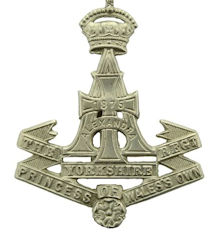
The Yorkshire Regiment, from 1920, is perhaps better known as the “Green Howards”. This title dates back to the wars of Austrian Succession in the mid 1700s. The Colonel at the time was named Howard. At this time, regiments were often referred to by the name of their Colonel. As the regiment was brigaded with another whose name was also Howard, there was duplication. So this regiment, which wore green facings to its uniform, became the “Green” Howards and the other regiment the “Buff” Howards. The “Green Howards” and the “Buffs” were names still in use in 1914-1918.
The 13th (Service) Battalion of the Yorkshire Battalion was formed in Richmond in July 1915 as a Bantam Battalion. It moved to Aldershot in July 1915 and came under orders of 121st Brigade, 40th Division and on the 2nd April 1916 it absorbed the 18th Bn, the Sherwood Foresters.
On 6th June 1916 the battalion landed at Le Havre and it seems probable that Arthur was with them. He had been married for less than 9 weeks.
At the time of his death, less than 12 months later, Arthur was serving with the 9th Battalion Yorkshire Regiment. The 9th had been formed as early as September 1914 and embarked for France, landing at Boulogne on 26th August 1915 where it was part of the 69th Brigade of the 23rd Division. Over the winter of 1915-1916 this Division spent almost five months in the front line and was subject to severe shelling in March 1916 and in the same month many miners were transferred from the Division to establish a Tunnelling company of the Royal Engineers.
On 21st May 1916 the German forces launched their attack on Vimy Ridge, a battle in which many British and allied men were killed and one in which the 23rd Division was involved. They were relieved on 11th June 1916 and it is possible that Arthur was transferred from the 13th to the 9th Battalion Yorkshire Regiment around this time to make up the numbers. This transfer was probably shortly after he landed in France on 6th June 1916.
The 23rd Division subsequently took part in several of the 1916 battles of the Somme between July and September 1916.
In mid October 1916 the 23rd Division were moved up to the Ypres sector for rest and “re-fitting”. This sector tended not to be so active as the front further south but there was significant spells of shelling and artillery bombardments including gas shells. The British forces were preparing for an offensive in this sector later in the year and this involved a great deal of tunnelling work. Many of the troops were required to both hold the front line but also support the Royal Engineers. It seems likely that Arthur was the victim of an artillery shell and shrapnel or gas.
Arthur is buried at the Railway Dugouts Burial Ground 3 miles south east of Ypres centre. He is one of 11 men buried here who were killed on 25th May 1917. Seven of these men came from the York and Lancaster Regiment who served in the same Division as the 9th Yorkshire Regiment. Arthur was the only man killed who was serving with the Yorkshire Regiment.
Private 23218 Arthur Lee Binns of the 9th Battalion Yorkshire Regiment is buried at Grave reference IV. F. 28 at the Railway Dugouts Burial Ground (Transport Farm). Railway Dugouts Cemetery is 2 Kms west of Zillebeke village, where the railway runs on an embankment overlooking a small farmstead, which was known to the troops as Transport Farm. The site of the cemetery was screened by slightly rising ground to the east, and burials began there in April 1915.
They continued until the Armistice, especially in 1916 and 1917, when Advanced Dressing Stations were placed in the dugouts and the farm. They were made in small groups, without any definite arrangement and in the summer of 1917 a considerable number were obliterated by shell fire before they could be marked. The names “Railway Dugouts” and “Transport Farm” were both used for the cemetery.
At the time of the Armistice, more than 1,700 graves in the cemetery were known and marked. Other graves were then brought in from the battlefields and small cemeteries in the vicinity, and a number of the known graves destroyed by artillery fire were specially commemorated. The latter were mainly in the present Plots IV and VII.
The cemetery now contains 2,459 Commonwealth burials and commemorations of the First World War. 430 of the burials are unidentified and 261 casualties are represented by special memorials. Other special memorials record the names of 72 casualties buried in Valley Cottages and Transport Farm Annexe Cemeteries whose graves were destroyed in later fighting.
Sources:
Commonwealth War Graves Commission
The Long Long Trail – The British Army in the Great War of 1914-1918 http://www.1914-1918.net/
NOTE: In 1921 His Majesty’s Stationery Office published a listing on behalf of the War Office of those officers and other ranks who lost their lives in WW1. This listing is known as U.K. Soldiers who died in The Great War 1914-1918. This listing records Arthur Lee Binns as serving in the 9th Battalion Yorkshire Hussars Regiment at the time of his death. The Commonwealth War Graves Commission (CWGC) on the other hand records him as serving in the 9th Battalion Yorkshire Regiment which a different regiment to the Hussars. It seems more likely that the CWGC is correct not least because the Yorkshire Hussars had only one battalion, the 1st.
Researched by
Members of Batley History Group