John (Jack) Thomas Walker 1897 – 1916
Family Details:
John Thomas was born on 25th June 1897 the son of Ephraim and Rachel Walker (nee Illingworth). He was baptised at St. John the Baptist, Daw Green on 14th July 1897 when the family was living at High Street and Ephraim was a miner.
Ephraim was born at Howden Clough, Batley and in 1901 the family which included his wife, mother in law, Mary Illingworth, daughter Clara (c1895), John Thomas, Laura (1901) and two boarders was living at 5, Sixth Street, Crofton .
It would appear his father was not very good to his family being drunk on 26th June 1905 and he was sentenced to 3 months at H.M.P. Wakefield on 27 August 1909 for deserting his family.
His mother died in 1909?
In 1911 “Jack” was a worker living with his maternal aunt Annie Eliza and her husband Edward Leak at Red Lane, Ravensthorpe. He probably became a porter at Thornhill Railway Station.
At the time he enlisted he was still living with his aunt and uncle at 53, Sackville Street, Ravensthorpe. His sister was a maid at the home of Mrs. Elizabeth S. Walker of De Grey House, Grosvenor Road, Batley.
Jack bid farewell to his aunt at the Lancashire and Yorkshire railway station at Thornhill in October 1915 never to return home.
Service Details:
John Thomas Walker originally enlisted in the King’s Royal Rifle Corps. The regiment was extremely proud of its history and was probably second only to the Guards Regiments in terms of status.
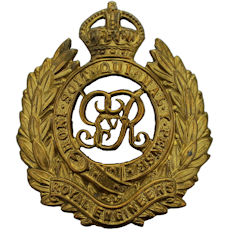
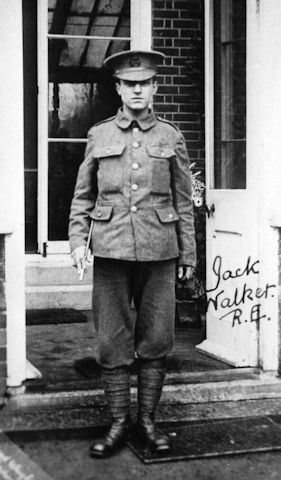 “Jack” was transferred to the Royal Engineers where he became a member of the “Special Brigade”. This unusual title was given to the arm of the Royal Engineers that was responsible for discharging poisoned gas towards the Germans by means of the “Gas Cloud”.
This type of attack was made by having the gas discharged from cylinders situated in the front line trenches. It was obviously important that the wind was blowing in the correct direction to ensure the cloud; upon it being discharged the cylinders did not linger and instead travelled across No Man’s Land towards the German trenches. The other method of using poisoned gas was via shells which were fired by the artillery. These, on exploding, discharged the gas directly at the point of impact.
The Special Brigade, Royal Engineers, was split into four battalions, Jack being in the Fourth.
In the days leading up to the battle the 4th Battalion, Special Brigade, R .E. was operating in the area of V1 Corps and had the responsibility for the part of the front line held by the 14th, 55th and 37th Divisions. This was to the north of a diversionary attack at Gommecourt, which itself was to the north of the main front to be attacked on the opening day of the battle of the Somme. Although these divisions were not directly involved in the Battle of the Somme there was a requirement to keep the Germans guessing as to where exactly the attack would be delivered and so many methods were used to try to make the Germans believe an attack was imminent elsewhere.
On 27th June the order was given that gas should be released as soon as a favourable opportunity presented itself and during that afternoon gas was released on the fronts of the 14th and 37th Divisions. The wind continued to be favourable the next day (28th) and the discharge of gas would probably have continued.
Due to the large area covered by the 4th Battalion of the Special Brigade there are no details in the battalion War Diary of any incidents during these days. There is however a brief summary of casualties this reports that on the 27th the battalion suffered five killed (including died of wounds) and 24 wounded. The following day there were nine deaths plus 44 wounded and 11 missing. The majority of these fatalities were as a direct result of gas poisoning (it is likely leakages and sudden shifts in wind would have caused these casualties). Jack Walker died of his wounds on the 28th June 1916.
S.D.G.W. states on 27th June, 3 were Killed in Action plus 1 died of wounds, on the 28th June, 3 were Killed in Action plus 8 died of wounds, 29th June 2 were Killed in Action plus 2 died of wounds.
John Thomas is remembered with Honour at Dewsbury Cemetery and Cross Bank Wesleyan Chapel.
He was awarded the British War Medal and the Victory Medal.
Military details are taken from “A Village Goes to War” by David Tattersfield
Researched by
Members of Batley History Group